Sat, 13 Apr 2013
Why are you doing all of this?
fijal just asked me, on IRC:
<fijal> paulproteus: if you have a second, can you tell me *why* are you doing all of this?
Briefly, here is the reason I work on OpenHatch:
For free software to take over the world, and for all users of software to be able to have control over their computing, we need a few things it seems to me.
- Software that is free ought to be better.
- That will probably take more collaboration and contributors.
- More people ought to feel comfortable doing things like filing bugs and participating in projects.
- For people to understand that, it helps a great deal if they know how to program.
- Free software contribution experiences are best when you have in-person communities to work with and bounce ideas off, or at least people who you know fairly well even if you collaborate remotely.
I think that explains basically all of what we do at OpenHatch.
[] permanent link and comments
Wed, 28 Sep 2011
Why it's important to defeat the network management infrastructure
I see the Internet as an ongoing conversation between millions of computers. Some of these computers are controlled by me or by my friends. When network administrators make it harder for our computers to send messages to each other, I get upset.
Angry, actually.
High school
I didn't always feel quite so strongly about this.
Twelve years ago, I was enjoying a foray into running a server at home. I was excited to connect to it from the Brighton High School computer network. I couldn't connect, though; I discovered that the high school's Internet connection was filtered through a proxy that only would connect to web servers.
I had an SSH server I wanted to connect to, so I could read my email in PINE. SSH isn't the web, so the proxy wouldn't let me through.
Then I learned about GNU httptunnel. This is a pair of programs:
- a server, that sits on my server at home and runs a fake web server; and
- a client, that I run at school, that lets me connect through the fake web server to the SSH service.
After some experimentation, I got the tools working.
From time to time, I would work on a file at home and forget to bring a copy to school. Now I could use the tunnel to connect to my desktop and download it.
From this experience, I took two lessons:
- Whatever network restrictions there are, I probably want to circumvent them.
- It will probably be reasonably easy to do so.
The experience reminds me of John Gilmore's famous quote:
The Net interprets censorship as damage and routes around it.
I enjoyed reading my email from school. I never felt I was endangering the high school network. I did try to set up my tunnels as fast as possible in case a teacher wandered by.
A conversation between computers
To many people, the Internet is a set of resources that humans can access.
To me, this is wrong for two important reasons:
- It is factually incorrect.
- It is a political mistake.
Factually speaking, every time you request a web page, you send a request to a remote computer to send it to you. That computer, upon receiving the request, can do whatever it wants. It is, approximately, sheer luck that when you visit an image like this twice, you see the same thing.
Politically speaking, this perspective hides one of the real crimes committed by Internet censors: fraud.
Four years ago or so, Comcast famously used heavy-handed techniques to prevent users from effectively using the BitTorrent file sharing software. If you belive in the Internet as a set of resources, there isn't all that much to complain about. After all, they let users access the whole World-Wide Web.
To see the world the way I do, you'll need some basic knowledge of Internet protocols. As a refresher, if you are on computer A, sending a file to computer B, Internet traffic between them generally looks like this.
First, a handshake:
- A -> B: Hi
- B -> A: Oh, hi!
- A -> B: I'm going to send you a file
- B -> A: Cool, go ahead.
Then the file transfer begins, sending chunks until they are all sent:
- A -> B: Here's one chunk
- B -> A: Great, send more chunks
- A -> B: All done sending
- B -> A: Hooray! I just love receiving files!
- B -> A: Okay, bye!
- A -> B: Bye!
Comcast does something exciting: in order to make the file transfer fail, Comcast sends you a specially-crafted message that appears to come from computer B. It says, "Okay, bye!"
So your computer stops sending.
From a user's perspective, the file transfer stops. At the network perspective, Comcast lied. Comcast is impersonating a remote party in a conversation.
Imagine with me, for a moment, that this is a phone conversation. When you call certain people, your phone operator is interrupting the conversation to play a message specially crafted to sound like your friend saying, "I have to go now!" You might hang up, thinking the call is over.
As it happens, in the Comcast BitTorrent blocking case, you can work around the tactic: if you configure your computer to ignore all "Okay, bye!" messages, the file transfer works fine.
If you see the web as a collection of resources, you might ask why your ISP is blocking access to a particular site. You might wonder why they're blocking BitTorrent.
If you're me, you'd ask: What gives them the right to lie about their identity when talking to you? To impersonate the computer operated by your friend across the 'net?
It strikes me as commercial fraud. Whatever sysadmin deployed this automated fraud technology needs to be put in jail -- if not him, then his boss.
Port blocking
Instead of actively impersonating a remote computer, another common tactic is to simply drop certain messages on the floor. This is most of what we ask "firewalls" to do. (Unless the network notifies you it did this, you can consider this a lie by omission.)
Many guest wifi networks drop Internet messages between computers based on the port number.
Different ports, for readers who don't know, are typically used for different kinds of services. A computer on the Internet can provide web service by listening on port number 80, and provide inbound email service at the same time by listening on port 25. The secure login service ("SSH") is usually found on port 22.
One of my housemates recently sent me an email complaining that she couldn't connect to her web hosting service. She was on someone else's wifi network. We eventually determined the cause: the network was dropping messages her computer sent to the hosting service on port 22. (Also, the organization in question outsourced their network management services, so there was no one in the building she could complain to.)
At this point, I got angry. The network admins are not making their network safer, but they are making it harder for her to do what she wants. Port 22 is not a dangerous thing to permit people to use.
So I configured one of my servers to listen on a port she could access. Like the GNU HTTP tunnel configuration I used in high school, the machine would relay messages from her limited network into the real Internet. In this case, we used sslh on the server, and configured her computer's SSH client to use a "ProxyCommand."
Moments like this remind me that the Internet -- that is, the routing of messages between computers, between (inter) networks (net) -- is vanishing before my eyes. I'm lucky in that I remember the old way; I started to use the Internet in an era where you could expect that packets would actually be sent to their destination, not rudely dropped on the floor or impersonated.
Summary
Now, it is normal to see packets mangled by Internet service providers. ISPs forge IP headers, sometimes to make the network seem faster, other times to insert advertisements into other people's web pages. Usually there is no way to opt out.
What all these network tricks have in common is that the ISP impersonates one party in the conversation.
When I ask the network to please send a message to another computer for me, I'm not asking to be lied-to.
[] permanent link and comments
Sat, 09 Oct 2010
My response to the FSF's "Windows Phone 7" email
The Free Software Foundation sent out an email recently about Windows Phone 7. I had some feedback for them, and so I share them with you, dear readers.
You should probably read the original mail first so that you can read my message with full context.
From: Asheesh Laroia
To: info at fsf.org
Subject: Re: [FSF] Windows Phone 7: The Best Choice For Patent Trolls
On Fri, 8 Oct 2010, peterb@fsf.org wrote:
Windows Phone 7: The Best Choice For Patent Trolls
BOSTON, Massachusetts, USA -- Friday, October 8th, 2010 -- The Free
Software Foundation (FSF) today issued a warning to consumers over
Microsoft's upcoming Windows 7 Phone Series. The software release is
backed by a reported 400 to 500 million dollar marketing campaign that
aims to distract consumers from its history of abusive behavior, and
recent actions as a patent troll: attacking free software based phones
like Android.
Hi Peter + FSF,
I'm a member, and I just want to say that this email sounds like bizarre
scare rhetoric. Doubly so when there are no details in the email. (Also,
it uses British English even though FSF is an American organization, which
is confusing to my American ear.)
"The Best Choice for Patent Trolls" is practically Slashdot-level
flamebait.
I understand you are angry, but please remember that your members aren't
always as informed as you. So you have to keep us interested, then inform
us, so we can be on the same page.
Phrasing like this just make me uninterested:
"Windows 7 Phone Series is another cookie-cutter example of Microsoft's
bumbling maliciousness to everything it does.", said Matt Lee, FSF
campaigns manager
Microsoft is "bubling" and "malicious" with "everything it does"? Overgeneralizations
don't help convince; they just amplify existing divides. Anyone reading the email who
isn't already a true believer has just stopped reading.
If the point of this email was to be an angry rant, then fine. If the
point was to inform people, explain the FSF's position, and garner support
for the FSF's priorities, then I don't think it worked.
You can ask other FSF members what they think, if you want to get a sense.
"Microsoft's damaging approach to software freedom, coupled with their
utter contempt for customers and developers alike, has produced
yet-another-platform of systematic control. This is a platform designed
only to appease its shareholders and help the folks at the MPAAs and
RIAAs of the world feel better about the chaos they seek to foster
surrounding digital restrictions and other technical folly imposed on
computer users."
"Yet-another-platform of systematic control" -- I'm confused. What other
platforms of systematic control has Microsoft produced? MS-DOS was a
rather open platform (for its time, and for the PC context), and later
Windows mobile phones had the ability for users to install whatever
software they wanted. Users regularly flash custom firmware onto these
phones. It's proprietary as all get-out, so it's far from perfect; but
it's not "systematic control".
So I literally do not know what "other" "platform of systematic control"
Microsoft has made. Honestly.
Oh -- now that I'm thinking about it, the Xbox is a good example. I was
involved in the Xbox-Linux project, and I remember all that very well.
But the anger in your words actually prevented me from remembering it. No
joke! I've been meaning to write this email to you since last night, and I
couldn't think of an example of an MS "systematic control" platform until
right now.
Free software is hugely important to our society. I hope that the FSF
can take this feedback in stride and keep working to inform us about
threats to software freedom.
I also decided to publish this at
http://asheesh.org/note/free-culture/fsf-on-windows-mobile.html
because I want to see if other people feel the same way I do.
With sincere hopes that you will improve,
-- Asheesh.
--
A vivid and creative mind characterizes you.
[] permanent link and comments
Thu, 26 Mar 2009
FSF Award for Projects of Social Benefit
Last weekend, I attended the Free Software Foundation's LibrePlanet 2009 conference.
The first day was a full day of talks from Free Software luminaries including Jeremy Allison of Samba and Evan Podromou of identi.ca. During the talks, the conference IRC chat room was brimming with conversation; between talks, so were the hallways.
The day concluded in an award ceremony. We joked around on IRC:
<paulproteus> Man, I probably didn't get EITHER award.
<gmaxwell> paulproteus, cause I got both! ha!
Richard Stallman happily presented the Award for the Advancement of Free Software to Wietse Venema for writing the Postfix mail server. Then he continued to announce the Award for Projects of Social Benefit, awarded...
"...to Creative Commons."
Mike Linksvayer kept sitting at his laptop.
"Shouldn't we go get that?" I asked him.
"Yeah," he answered, not moving from his computer.
"Should I come with you?" I asked.
"Yes," he said crisply.
And up we went.
Richard handed Mike the award, and I stood next to Mike as Richard explained to the audience that he wished Creative Commons would talk more about freedom. As Mike accepted the award from the lectern, I did my best to not grin like an absolute idiot. I managed to look somewhat serious in the photo as Mike cropped it; maybe that's the effect of the shadows.
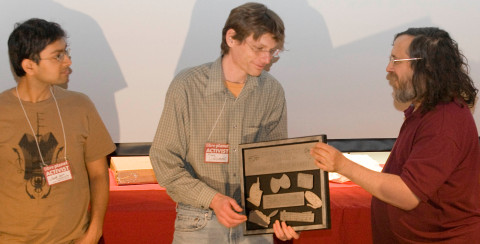
Asheesh Laroia and Mike Linksvayer of Creative Commons accept the 2008 Free Software Foundation Award for Project of Social Benefit from Richard Stallman. Detail of photo by Matt Hins / CC BY-SA. (Cropped image and this caption by Mike.)
I was immensely pleased. Creative Commons and Free Software, as organizations and as movements, are about lifting unneeded or immoral burdens copyright law levies on people who want to remix, improve, and share. These movements tie together as Free Culture, and they have been a huge part of my life. Moreover, Free Software was the first empowerment movement I could concretely understand.
"Happy hacking!" said Stallman to us as we walked off stage.
[] permanent link and comments
Thu, 20 Mar 2008
The ninth graders
On Thursday, March 6, I spoke to a room full of ninth graders at the French-American International High School in San Francisco.
Two months ago, some faculty there emailed the San Francisco Linux Users Group (really, they emailed Jim Stockford, who passed it along). They explained that they were having a full day off classes for students on what they termed "Internet Day," bringing in outside speakers to talk about issues related to computer technology.
One of the most interesting things is that the event was organized by a remarkable high school senior, Joseph Harder. But long story short, I emailed them saying with my background and said I could talk, and they invited me.
So two Thursdays ago, I woke up at 8:30 a.m. and thought, "Man, I should make a presentation for these guys. I have to be a lunch at 11:30 to meet the other presenters." Then I thought better of it. "I'll go to sleep for another half hour."
Now fully prepared (at least as fully as I was going to be), I arrived at lunch only a few minutes late. I met some other presenters: Craig Newmark (famous for his List), a Google laywer, and a Boalt Hall faculty member, to name a few. I felt pretty clearly outclassed, but I figured if I didn't let them know how outclassed I was then at least I could have a normal conversation with them.
My presentation was to (I think) all the ninth graders in the school. There were between 60 and 80 of them in the room, I'd guess. I was co-presenting with Christian Einfeldt, Producer of the Digital Tipping Point film about Free and Open Source Software. Through the Socratic method, he spoke about "ownership," explaining to the students that when you run proprietary software, you are not in control of your computer.
I then spoke about copyright law and what Creative Commons is. I began by giving props to Christian, pointing out that the same Richard Stallman Christan referred to had signed my laptop. (It does turn out that my involvement in Free Software goes deeper than that, but it didn't seem important to list all of my million hats.)
I gave what looks like a very Larry-inspired presentation - sparse slides, and alignment tricks to make my points clearer. It was a total blast. To name only one difference between this presentation and a real presentation by Larry, I treated the slides and my presentation as one half of a conversation; Larry's rock-star Free Culture talks have him whip through things so fast you're mesmerized, but there's no time for questions in the middle. I let the kids ask me questions all through the talk, which was oodles of fun.
You can see the slides here, but the real joy of the event was in the interaction between me and the students. Some highlights:
A beginning
I began by pointing out:
- Copyright is Federal law
- Copyright is international law
- Copyright is not necessarily a system of morals
It's just the way the law is written right now.
- I asked, "How did we end up in this terrible mess of copyright law?"
- I then flipped right through the words "disney + world" on their own slide, and switched to a picture of the Magic Kingdom at Disneyworld.
- The kids are oohing and aahing and cheering, "Disney, yay!". I know I won't have their attention until they get this out of their systems, so I just stand around smiling for twenty seconds or so.
- Then, naturally, I explain how Disney movies are largely fairy tales retold, and that Disney lobbies Congress to make sure no one can do to them what they did to to the Brothers Grimm. (A total Larry line, but it's a good one.)
- Kids in the audience actually remembered the original Napster. They must have been in second grade!
- One asked, "Is that the cat?"
- (I said, I guess it's a cat....)
- And many of them actually said they used it, which I found amazing.
- Somewhere toward the middle of the presentation, just as I was finishing explaining how copyright was "worthless" to people who wanted to use and reuse (and participate in!) culture, a staff member whose name sadly escapes me asked me the obvious question: How will people make money?
- I told her I'd get to her question toward the end, when I covered Nine Inch Nails. Turns out that while I said they made $750K of revenue, they actually made 1.6 million dollars in the first week.
A conclusion
- The way I explained Creative Commons was through the comparison of Metallica and Nine Inch Nails.
- Metallica sued Napster, whereas Nine Inch Nails just released a full album (or four, depending how you see it) under a Creative Commons license.
I explained the exact license NiN chose with the CC symbols. As I finished up, I summarized this as:
Nine Inch Nails: Ghosts IIV promises not to sue you for making a music video and putting it on YouTube.
One kid asked me, "Is that a legal promise?" This question reaches to the heart of what Creative Commons tries to do - decrease uncertainty about using other people's work when they don't mind. I answered, "Yes," and explained a little of the history of CC.
My last few slides were:
Nine Inch Nails: Ghosts IIV respects you.
Which was followed by:
Metallica
does not.
So I got some great applause at the end, which felt marvelous, and then we had about five minutes more for questions. Two questions took up three minutes, and I realized I had forgotten to ask them this question that occurred to me earlier in the morning. So I said:
"Will the people follow the law, or will the law follow the people?"
I tried to get them to take some charge in changing laws that do them more harm than good. Some copyright may be useful, but it's hard to argue we haven't gone too far.
I got just about the same thunder of applause, and then they
Epilogue
As literary convention would have it, this story has an epilogue. I had some good conversations at the end, including discussing Free Software with one Mac user student who pretty clearly knew what he was talking about. Christian spent quite some time talking about his Digital Tipping Point film with the staff member whose name I have still, sadly, forgotten.
I also received an email that looked like this:
Date: Fri, 7 Mar 2008 05:55:24 +0000 (GMT)
From: Student <something@yahoo.fr>
To: asheesh@creativecommons.org
Subject: tech seminar at ihs
hey i rly enjoyed your talk today and i did wat u said and got the NIN
cds... there rly good and i just wanna say thank u a lot and i hope ull be
at the next seminar
Well, that was nice. I'm left with warm fuzzies and the desire to do something like this again.
[] permanent link and comments
Sun, 09 Dec 2007
Refuting trademarks, Slashdot style
There's a new Free math package called Sage. However, some Slashdotters fear impending trademark problems.
Luckily, all is well:
no worries, an herb has prior art on the name.


